
2026 Democracy Report drops: What Japan Can Do
Updated: Apr 15
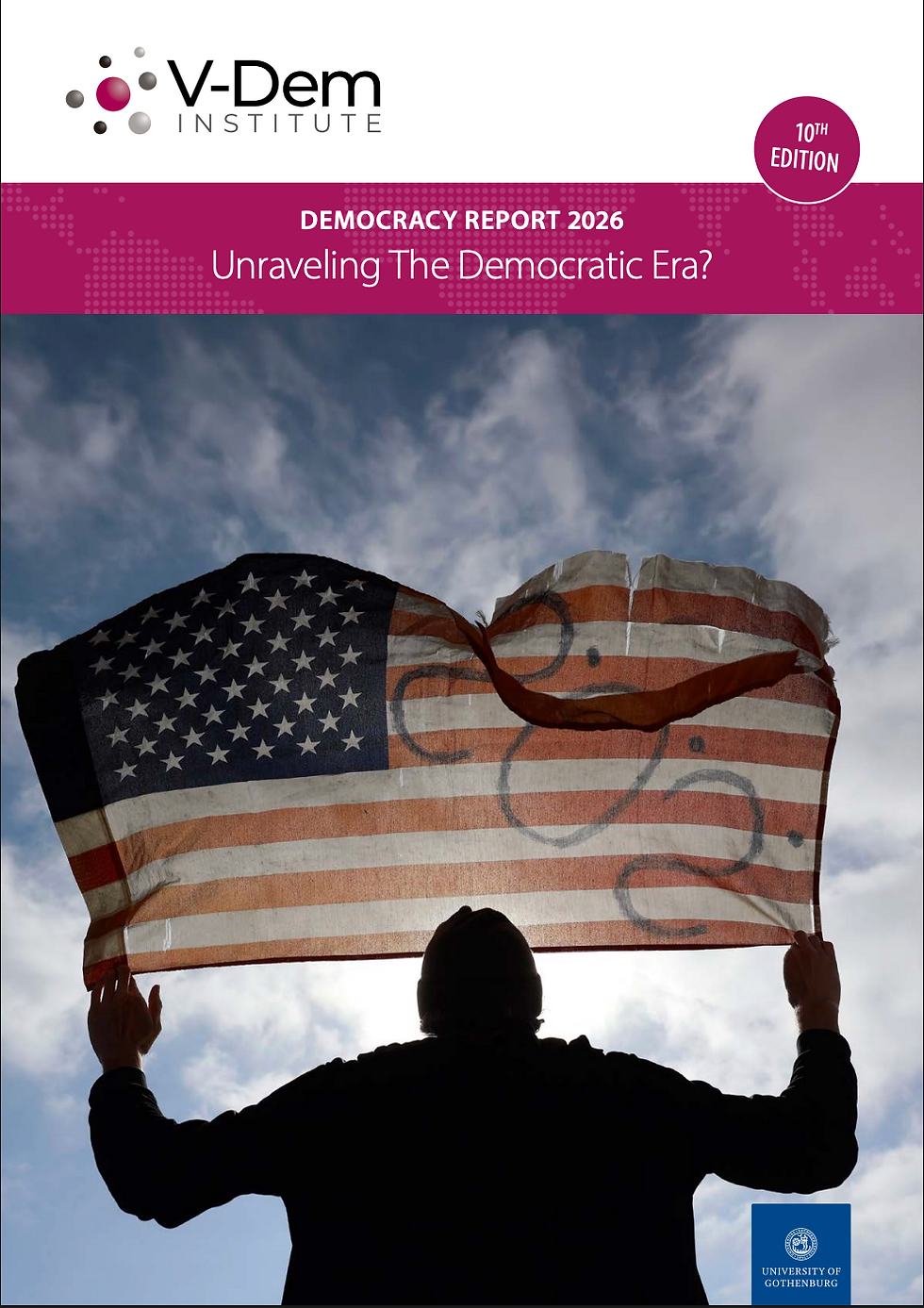
In March, the V-Dem Institute released its tenth annual Democracy Report 2026 It is not comfortable reading.
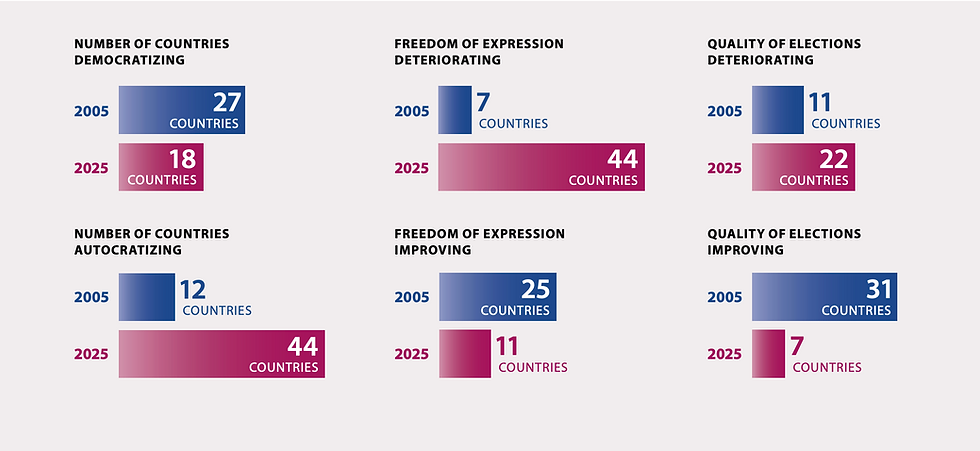
For the average global citizen, democracy has fallen back to 1978 levels. The enormous expansion of freedom that began with Portugal's Carnation Revolution in 1974--the "third wave of democratization" that transformed dozens of dictatorships into democracies across Southern Europe, Latin America, Eastern Europe, and parts of Asia--has been almost entirely erased. The current wave of autocratization, V-Dem concludes, is unprecedented in length, scope, and magnitude. Worse, by the data, than the 1930s.
Today, 74% of the world's population lives under autocracy. Only 7% live in a liberal democracy. The United States--for generations the world's most symbolically significant democracy--has lost its liberal democracy status for the first time in over 50 years, falling from 20th to 51st place in a single year. Seven EU member states are now autocratizing. The traditional anchors of the democratic world are themselves under strain.
These numbers are drawn from 32 million data points across 202 countries, assessed by over 4,200 scholars and country experts. The picture they paint is of a world in which the center of gravity for human experience and global governance has shifted, decisively and rapidly, toward authoritarianism.
Asia Is where crisis is deepest
If the global picture is alarming, the Asian picture is stark.
In East Asia and the Pacific, 68% of the population lives under closed autocracy. In South and Central Asia, 85% lives under electoral autocracy, with average democracy levels having fallen back to where they were in 1976. The region home to more than half of humanity has almost no democratizing momentum. V-Dem identifies just one stand-alone democratizer in all of South and Central Asia--Sri Lanka--and a handful of small, fragile states across the broader Pacific.
Meanwhile the large, consequential countries are moving in the other direction. India — the world's most populous country--is autocratizing. So are Indonesia, Pakistan, and the Philippines. China, North Korea, and Myanmar remain closed autocracies. In the space of a generation, the democratic promise that seemed within reach across much of Asia has retreated dramatically.
What makes this particularly sobering is the compounding effect. These are not small countries. India alone has nearly 1.5 billion people. Indonesia has 280 million. Pakistan, 250 million. When large, economically significant, geopolitically consequential countries autocratize, they don't just affect their own citizens--they reshape regional norms, alter international institutions, and make it harder for smaller neighbors to resist similar pressures. Democratic backsliding in Asia has a gravitational pull of its own.
And yet the gap between where the crisis is most concentrated and where philanthropic and civil society infrastructure exists to address it remains enormous. Global funders who want to engage Asia often lack the relationships, the regional knowledge, and the trusted local partners to do so effectively. The networks that sustain democracy work in Europe or Latin America--the funders, the advocates, the researchers, the connective tissue--are far thinner in Asia.
Japan's quiet importance
Against this backdrop, Japan's position deserves closer attention than it typically receives.
Japan is one of only three liberal democracies in East Asia and the Pacific--alongside Australia and New Zealand. In a region where more than two-thirds of people live under closed autocracy, that is not a minor distinction. Japan brings to this moment a stable rule of law, a functioning civil society, deep integration with global democratic institutions, and--critically--geographic and cultural proximity to the countries where the democratic crisis is most acute. It also carries significant geopolitical weight as the world's fourth largest economy and a cornerstone of the US alliance system in Asia, giving it credibility and access that purely civil society actors often lack.
Japan has not historically been a major actor in democracy support. For structural, cultural, and historical reasons, Japanese engagement with the harder edges of human rights advocacy, democratic institution-building, and civil society support has been limited compared to what its position might warrant. That is beginning to change--slowly, unevenly, but genuinely — as Japanese policymakers, academics, and philanthropists reckon with what an Asia in democratic retreat means for Japan's own long-term security and values.
The V-Dem report's findings on what actually reverses autocratization are instructive here. Roughly 70% of modern autocratization episodes have been turned around. What makes the difference, the research shows, is a combination of strong institutional safeguards, active and well-resourced civil society, independent media, and early action — ideally within the first electoral cycle. These are not military or geopolitical interventions. They are investments in people, organizations, knowledge, and trust. They are precisely the kinds of investments that a well-positioned philanthropic actor, operating with a long time horizon and genuine regional relationships, can make.
Japan is not the only country that can play this role. But it may be uniquely positioned to play it in Asia--combining democratic credibility, regional embeddedness, and geopolitical weight in a way that few other actors can match.
A moment that requires a response
The V-Dem report was released just weeks before we launched the A Better Future Foundation. The timing was not planned, but the alignment is not coincidental. The conditions the report describes --the depth of the crisis, the particular vulnerability of Asia, the gap in philanthropic infrastructure, the window that still exists for democratic reversals — are exactly the conditions that convinced us this foundation needed to exist, needed to be based in Japan, and needed to operate at the intersection of Japanese civil society and the global democracy support ecosystem.
We will have more to say in the weeks ahead about what that means in practice. For now, we simply note: the data is clear, the need is real, and Japan has a role to play. We intend to be part of how it does.
All images for this piece are taken from the V-Dem Institute Democracy Report 2026.

Comments